

Index
- Cost of dyeing clothes vs. buying new: a direct comparison
- Professional dyeing costs: when to hire an expert
- How to dye clothes in the washing machine: a practical step-by-step guide
- Best Fabric Dyes: How to Choose the Right One for Your Garment
- The time-cost trade-off: when home dyeing isn't worth it
- Fashion sustainability and creative recycling: the environmental impact you don't see on the price tag
- Conclusion
Publication date: August 5, 2026
Cost of dyeing clothes vs. buying new: a direct comparison
The cost of dyeing clothes is one of the most overlooked topics when it comes to sustainable wardrobes. Many Italian consumers dismiss the idea of dyeing a garment without ever doing the math, believing it's complicated or the savings are minimal. This article by Aybel debunks that prejudice with concrete numbers and an honest comparison of the two options.
Dyeing a garment at home costs a fraction of the price of an equivalent new item. Time, fiber type, expected result, and environmental impact all factor into the equation. Below, you'll find a comprehensive analysis to help you decide when it's worth dyeing and when it's worth buying new.
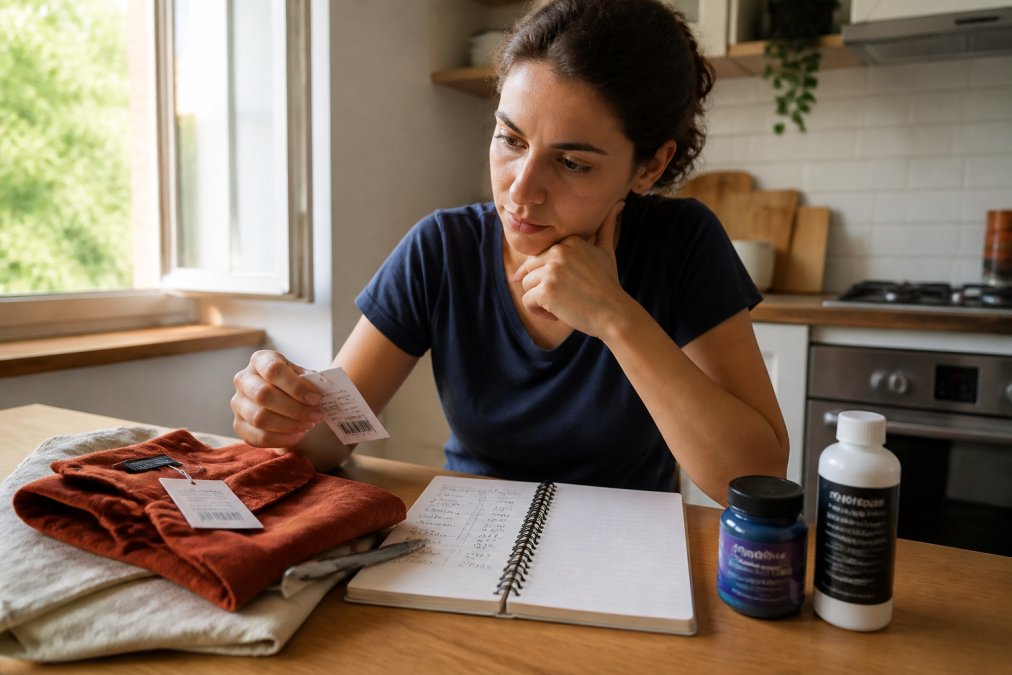
How much does it cost to dye a garment at home?
Dyeing a garment at home has a very low direct cost. A quality fabric dye package, such as Aybel, starts at around €4.99 for single colors like Black or Bright Lilac . Add to this the €4.99 Fiske Fixing Agent , which ensures the color lasts over time. The total for a single dye job is therefore around €10-12 for most natural fiber garments.


| Cost item | Approximate cost | Notes |
|---|---|---|
| Fabric dye (1 piece) | ~€4.99 | Aybel, single color |
| Fixing agent | ~€4.99 | Aybel Fiske, makes color last longer |
| Table salt (if required) | ~0,20 € | Often already at home |
| Hot water / washing machine energy | ~0.30-0.50 € | Cycle at 40°C |
| Estimated Total | ~10-12 € | For a medium-sized garment in natural fibre |
You can renew a shirt, a pair of cotton trousers, or a linen skirt for less than it would cost to buy a coffee and a croissant every day for a week.
The real cost of buying a new item
A medium-quality wool sweater in Italy is rarely found for less than €40-60. A cotton shirt from a mid-range brand starts at €25-35. For higher-quality clothing, prices quickly rise above €100.
According to the Ellen MacArthur Foundation's research on the circular economy in the textile sector , the fashion industry generates enormous hidden costs throughout the entire production chain: transportation, packaging, disposal of unsold garments, and the environmental impact of production. Dyeing, on the other hand, extends the life of a garment you already own, that you know, and that you know how it will perform in the wash.
Professional dyeing costs: when to hire an expert
Hiring a professional dry cleaner makes sense in specific cases. The cost can range from €20 to €50 or more for a single garment, with no guarantee of consistent results on previously used items. Industrial dry cleaners are geared toward the B2B market and require minimum order quantities that are not suitable for private consumers.
The cost of professional garment dyeing is convenient when:
- It is a formal dress or a high-value item (leather, fine silk)
- The garment requires complex technical workmanship that cannot be replicated at home
- A written guarantee of the result is required
For all other cases, DIY with quality products offers a significantly superior quality-price ratio.
How to dye clothes in the washing machine: a practical step-by-step guide
Dyeing clothes in the washing machine is the simplest and most consistent way to achieve professional results at home. The process takes about 30-60 minutes of active washing, plus prep time.
What you need before you start
- Fabric dye compatible with the garment's fiber (e.g. Aybel, suitable for cotton, wool, silk, linen, viscose, bamboo, and polyamide)
- Fixing agent to ensure color durability
- Table salt (about 250-500 g)
- Rubber gloves
- The garment to be dyed must be clean and damp
- A washing machine with a compartment for additives
The step-by-step process:
- Wash the garment without fabric softener to remove residues that would hinder the absorption of the color.
- Leave the garment damp, not wrung out
- Pour the dye into the additive compartment or directly into the basket
- Add salt to the basket to help the dye absorb evenly.
- Set the program to 40°C with a full cycle
- Once finished, add the fixing agent and start another short cycle
- Run the washing machine empty on a 60°C cycle to remove dye residue.
Common mistakes to avoid
L most common mistake is not wetting the garment before washing it. A dry fabric absorbs the dye unevenly, creating stains and lighter areas. Another common mistake is skipping the fixative: the color will appear bright immediately after dyeing, but will fade quickly after the first few washes without this step.
Also avoid overloading the washing machine: the garment must move freely in the drum for even dyeing.
Best Fabric Dyes: How to Choose the Right One for Your Garment
Choosing the best fabric dyes depends primarily on the composition of the garment you want to dye. There's no universal dye that works equally well on all fibers.
Reactive dyes , such as those used in Aybel dyes, are particularly effective on cellulose fibers (cotton, linen, viscose) and protein fibers (wool, silk). They guarantee excellent color fastness and intense color rendering, even with home processes.
Analysis by fiber type: cotton, wool, silk and synthetics
| Fiber type | Recommended colorant | Ideal method | Color fastness |
|---|---|---|---|
| Cotton, linen, viscose | Reactive / direct | Washing machine or hand | High |
| Wool, silk | Acid / reactive | By hand in hot water | High |
| Polyamide (Nylon) | Reactive / acid | Washing machine or hand | Medium-high |
| Pure polyester | Dispersed (high temp.) | Industrial only | Low with home methods |
| Mixed fibers | It depends on the prevalence | Test first | Variable |
Cotton garments are the easiest to dye and guarantee the most uniform and long-lasting results. Wool requires more attention to temperature to avoid shrinkage. Silk absorbs dyes beautifully but must be treated gently, preferably by hand.
For pure synthetic fabrics, home dyeing is not the right solution: natural fiber dyes do not chemically bind to synthetic fibers.
The time-cost trade-off: when home dyeing isn't worth it
Dyeing your clothes at home isn't always the right choice. Time is a real cost. A complete dyeing cycle in the washing machine, including preparation, washing, fixing, and cleaning the machine, requires an average of 2-3 hours of active attention and waiting.
Here's when home dyeing isn't a good idea:
- Garments made of pure polyester or 100% synthetic fibres : the dye does not fix
- Very light garments on which you want to obtain a dark color : may require more steps
- Garments with prints, embroidery or inserts in different materials : the different fibres will absorb the colour differently
- When the garment is already very worn : the dye does not cover the signs of wear
- When you're in a hurry : Dyeing requires time and attention
For the vast majority of garments made from natural or semi-synthetic fibers, the trade-off is largely favorable. Spend less than €12, dedicate 2-3 hours, and get a garment that looks new. According to the European Environment Agency's textile sustainability report, extending the life of an existing garment is always the least impactful option.
Fashion sustainability and creative recycling: the environmental impact you don't see on the price tag
The textile sector is among the most impactful globally in terms of water consumption, CO₂ emissions, and waste production. According to Greenpeace Italy's data on the fashion industry , clothing production is responsible for a significant share of global water pollution, partly due to chemical runoff from untreated industrial dyes.
Home dyeing, done with products formulated for private use and in small quantities, has a radically different impact. Renewing a garment instead of buying a new one means:
- Reduce demand for new textile production
- Reduce clothing waste going to landfills
- Limit emissions related to the transportation and logistics of fast fashion
- Promote quality items that would otherwise be discarded
Fast fashion has accustomed many consumers to treating clothes as disposable. A faded garment too often ends up in a dry-cleaning bag instead of a dye. This is avoidable waste, both economically and environmentally.
According to the guidelines of the European Union's Circular Economy Action Plan , extending the useful life of textile products is one of the strategic priorities for reducing the fashion industry's environmental impact in the coming years. Dyeing a garment instead of throwing it away is, quite literally, the choice Europe is promoting.
The question "dye cost vs. buying new" has a clear answer in most cases: dyeing costs less, pollutes less, and often produces better results than expected. Aybel was created to solve this very problem: with fabric dyes starting at €4.99, suitable for cotton, wool, silk, and other natural fibers, a personalized color consultation service, and a professional fixing agent, achieving consistent, long-lasting results at home is within everyone's reach. Discover the full range at aybel.shop and give your favorite garments a second life.
Frequently Asked Questions
Should you dye your clothes or buy new ones?
Dyeing a garment at home with products like Aybel costs between 5 and 15 euros total, including fixative. Buying a new garment of equivalent quality can cost from 20 to 80 euros or more. If the fabric is in good condition and the fiber is natural or semi-synthetic, home dyeing is almost always the most economical option. Also consider the sentimental value of the garment: renewing it has a meaning that the price alone doesn't convey.
How much does it cost to dye a dress at home?
The cost of home dyeing depends on three factors: the dye (starting at €4.99 for a single Aybel package), the fixative such as Aybel Fiske (€4.99), and the hot water or energy consumption of the washing machine, estimated at less than €1 per cycle. In total, dyeing a single garment generally costs between €10 and €15, much less than the cost of professional dyeing, which requires a quote and can vary significantly.
Which fabrics can be easily dyed at home?
The best fabric dyes work best on natural and semi-synthetic fibers: cotton, linen, silk, wool, viscose, bamboo, and polyamide (nylon). Pure synthetic fabrics like polyester absorb dye very little. Before dyeing, check the garment's label: a composition of at least 60% natural fibers ensures uniform and long-lasting results.
Is dyeing clothes an eco-friendly choice?
Yes, compared to buying a new garment. Industrial textile production consumes enormous amounts of water and generates significant chemical waste. Dyeing an existing garment at home avoids all this, extends the life of the fabric, and reduces waste. Choosing home dyeing is a concrete form of fashion sustainability and creative recycling, consistent with the principles of the circular economy and conscious consumption.
This article was written using GrandRanker